
Knowing Oneself: Johari Window

In society today we often place importance on knowing oneself. After all, ‘Know thyself’ (“Γνῶθι σεαυτόν”) was inscribed upon the Temple of Apollo in approximately the 4th century BCE. Knowing oneself became a topic written and debated by philosophers such as Socrates, Plato, Descartes and the Stoics. In psychology, Freud quotes the original Greek in his book Psychopathology of everyday life.Jung is often paraphrased saying ‘Until you make the unconscious conscious, it will direct your life and you will call it fate’. It is thus safe to assume that there has been a large amount of literature on this topic.
In 1955, two psychologists Dr. Joseph Luft (1916–2014) and Harrington Ingham (1916–1995) developed what became known as the Johari Window. The name comes from a combination of the authors first names, the Joe-Harry window. The Johari Window is a simple model that helps us understand self-awareness in the context of others. It describes four “windows” of the self.
- The Open Area: What you know about yourself and others know about you.
- The Blind Spot: Where others see things in ourselves that we cannot.
- The Hidden Area: What you know about yourself but keep hidden from others.
- The Unknown Area: Parts of you that neither you nor others are aware of yet.
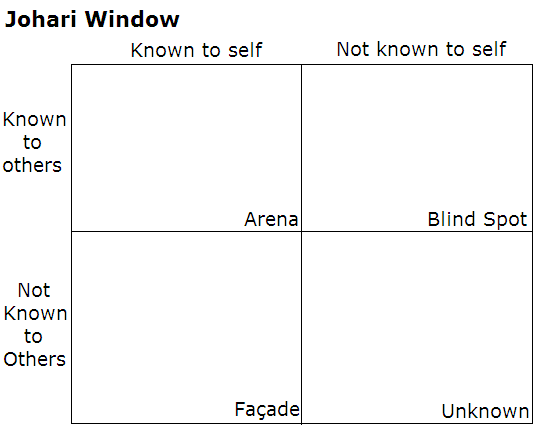
Johari’s Window has been used in psychology, coaching and personal growth contexts. It demonstrates that in order to know ourselves, we need other people. These can be friends, partners or even professionals who see parts of ourselves that we may not be aware of.
I must admit that I could not find nor access a copy of Luft’s original books -On Human Interaction and Group Processes. I did, however, find that Joseph Luft died in 2012 after being struck by a car. I could not find much information regarding Joseph Luft nor Harrington Ingham, aside from obituaries. While Johari’s Window may not be as significant as Freud’s concept of the Unconscious or Socrates Dialogues, I feel unsatisfied that there is very little known about them and their lives. Johari’s Window gives us a simple way to understand different aspects of ourselves.
If you would like to learn more about yourself, your Blind spot or Unknown Area, I am available at Thrive Psychology.
-Steve
References
Freud, S. (1966). Psychopathology of everyday life. WW Norton & Company.
Green, M. S. (2018). Know thyself: The value and limits of self-knowledge. Routledge.
Jung, C. G. (1959). Aion: Researches into the Phenomenology of the Self. Pantheon Books Inc.
Luft, J. (1961). The Johari window: A graphic model of awareness in interpersonal relations. NTL Human Relations Training News, 5, 6–7.
Ryan, T. (2018). Johari window. In The SAGE encyclopedia of educational research, measurement, and evaluation (Vol. 4, pp. 909-909). SAGE Publications, Inc.